
Generate a generic fluid dynamics dataset for training data-driven surrogate models. This dataset can help researchers benchmark and compare models.
Motivation and problem definition
Most researchers currently create their own datasets based on specific use cases in narrow simulation space. This makes it hard to compare multiple models without redoing them. We plan to create a benchmark dataset with a wide range of three-dimensional channel flow simulations, with varying complexity so that it fits the requirements of a larger group of researchers.
Methods and codes
We generate the geometries (comprised of cone, cylinder, hexahedron, sphere, and torus) using CadQuery a python library to generate CAD models. We perform the simulations using waLBerla a Lattice Boltzmann method developed at the Chair for System Simulation, Computer Science 10, Erlangen. For the dataset, we generate random geometries and choose random simulation parameters within defined ranges for the simulation.
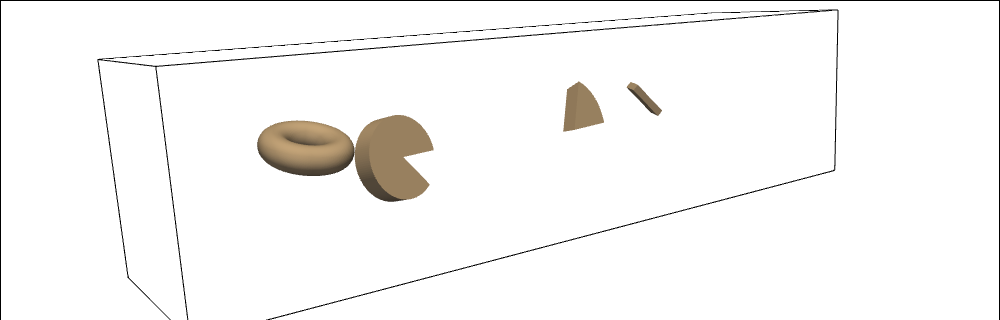
Figure 1: An example channel flow simulation with an inlet velocity of 0.1488m/s and a Re of 10000. This image shows the randomly generated geometry along with a bounding box representing the simulation domain.
Results
We will have a publically available fluid dynamics dataset that can be used to benchmark and compare multiple surrogate models. We also hope this would help researchers who do not have the expertise or required computational resources to work on surrogate models for fluid dynamics.
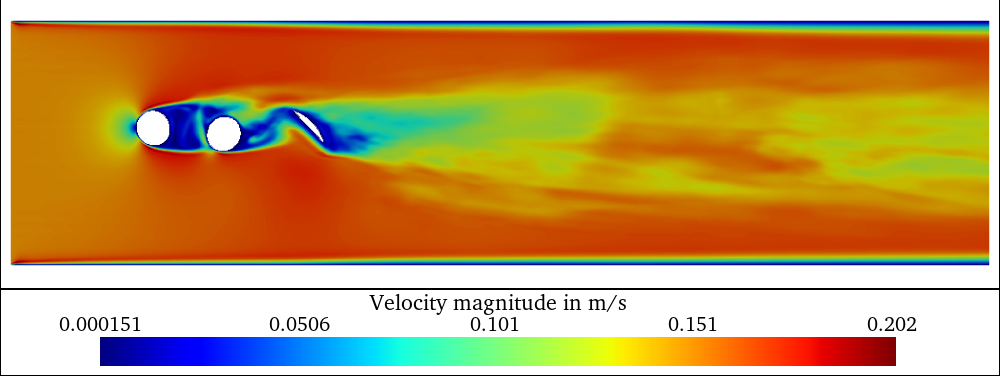
Figure 2: An example channel flow simulation with four randomly generated geometries with an inlet velocity of 0.1488m/s and a Re of 10000. This image shows a slice of the average velocity field after simulating for 100 seconds.
Researcher’s Bio and Affiliation
Sam Jacob graduated in Computational Engineering at the FAU Erlangen-Nürnberg. He is now working on his PhD under the supervision of Dr.-Ing. Harald Köstler.
Contact:
Sam Jacob Chair of Computer Science 10 (System Simulation) Friedrich-Alexander-Universität Erlangen-Nürnberg
Mainly used HPC resources at RRZE
Emmy Cluster