
Our best wishes, Dr. Afzal, on getting your PhD!
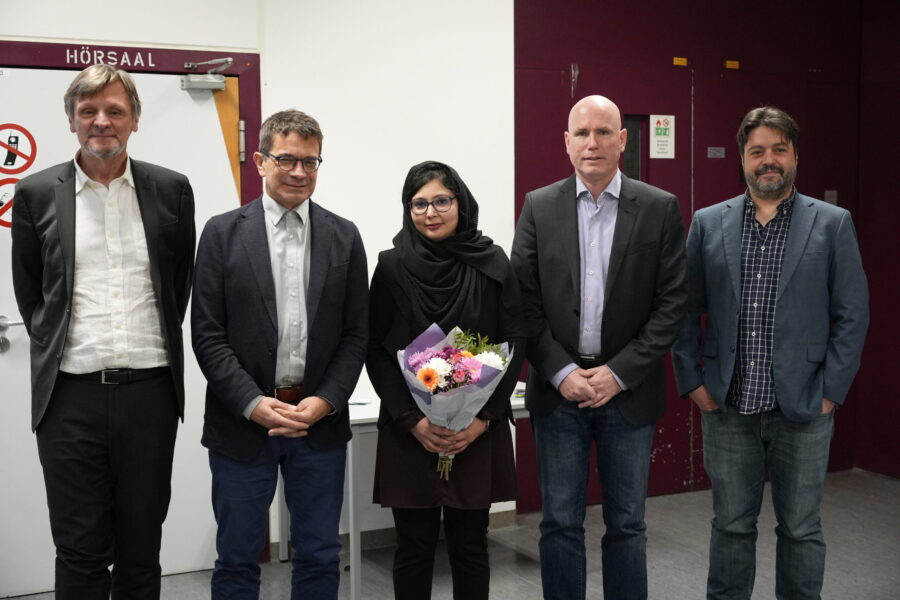
Another success story from NHR@FAU: On February 19, doctoral candidate Ayesha Afzal successfully defended her thesis and thus completed her PhD supervised by Prof. Dr. Gerhard Wellein.
In her research, Ayesha worked on “A Holistic White-Box Approach to Performance Modeling for Supercomputing.” She investigated interesting performance patterns that appear in highly parallel programs running on supercomputers. Using “white-box” analytic performance models, she analyzed the underlying mechanisms of parallel program behavior, with a special focus on programs that do not fit the ubiquitous bulk-synchronous, or “lock-step” pattern that is common to many simulation codes.
To support these investigations, she developed DisCostiC, a performance simulator for MPI applications based on first-principles modeling, as well as OsciLite, a dynamical model that represents parallel processes as coupled oscillators. In addition, Ayesha’s work has already gained great scientific attention with several awards, such as the ISC PhD Forum Award and the ISC Best Research Poster Award.
Her defense was attended by numerous guests, current and former NHR@FAU employees, friends, and family, who congratulated her. Of course, the defense was followed by a well-deserved celebration, and her colleagues had also prepared a few things: Ayesha had to answer some fun quiz questions identifying socket size, CPU type, and cluster name by charts of her previous research (our traditional “post exam”).
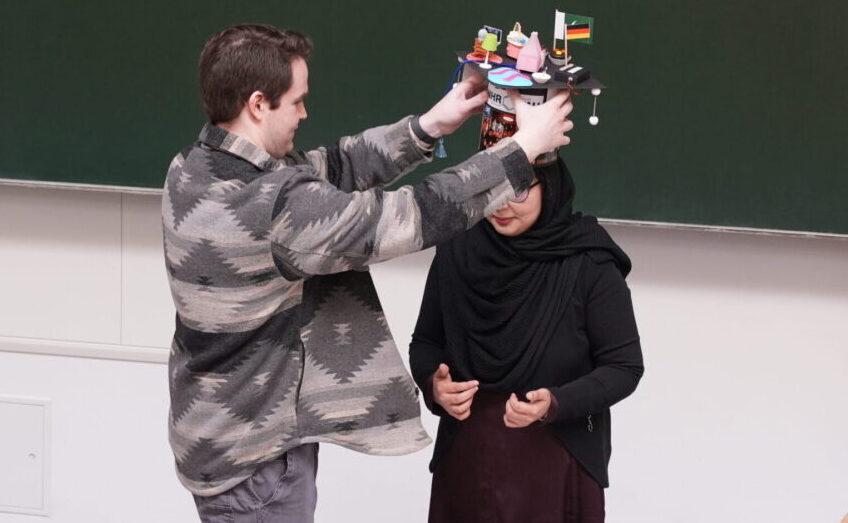
As a reward, she was given a homemade doctoral hat decorated with photos as well as symbols for her research topics and private life: pictures of her participation at the ISC in Hamburg and of her engagement for the NHR|WHPC Chapter, a flag of her home country of Pakistan, symbols for her children and family, and a little box with blinkenlights that showed auto-synchronizing behavior by simulating the Kuramoto Model.
We warmly congratulate Ayesha on her academic achievements, her enthusiasm for her research, and her confident defense. The world of HPC will certainly be hearing more from Dr. Afzal in the future, and we look forward to continuing our joint research at the NHR@FAU.